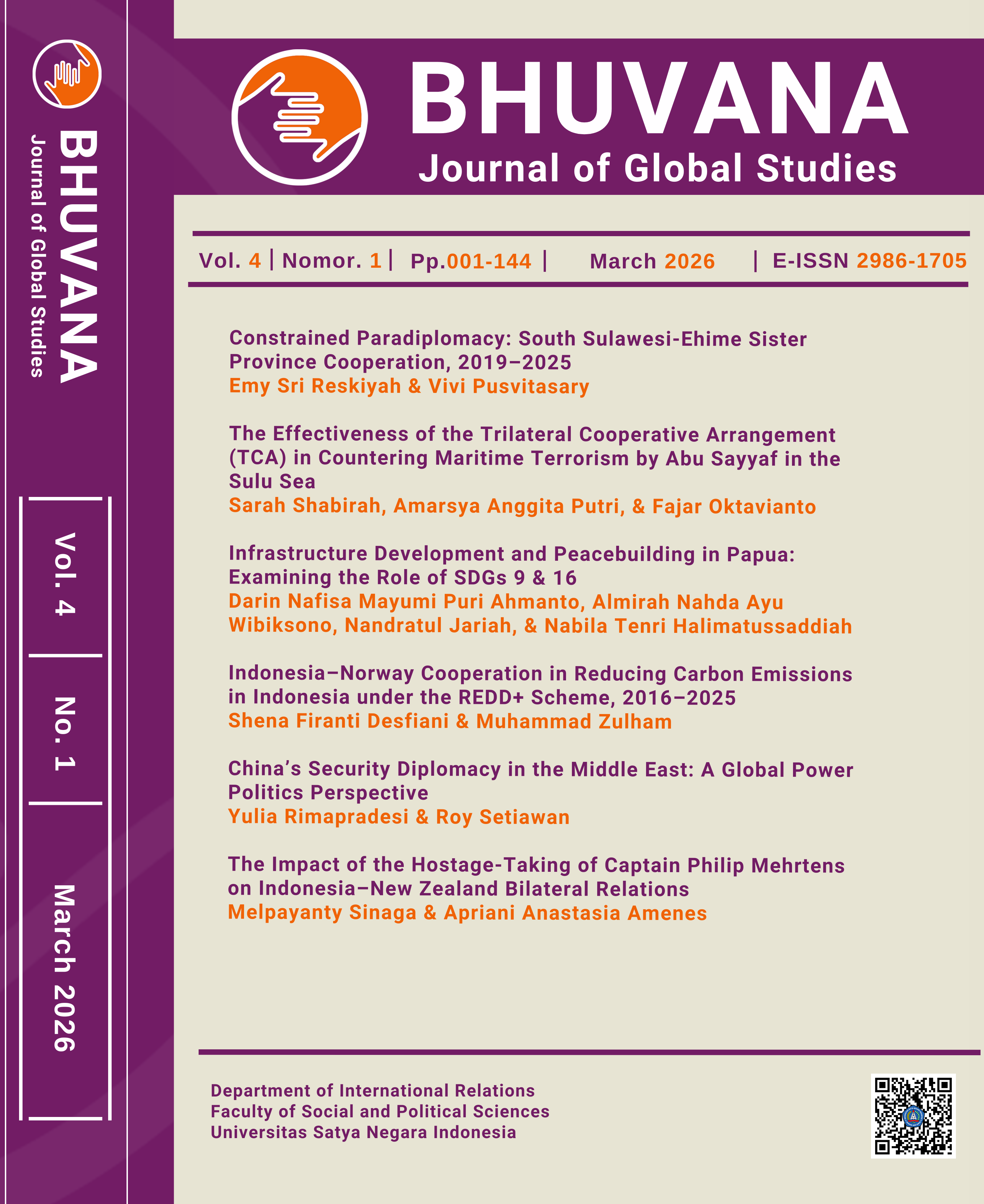
THE EFFECTIVENESS OF THE TRILATERAL COOPERATIVE ARRANGEMENT (TCA) IN COUNTERING MARITIME TERRORISM BY ABU SAYYAF IN THE SULU SEA
DOI:
https://doi.org/10.59408/bjgs.v4i1.250Keywords:
Trilateral Maritime Patrols, Abu Sayyaf, Maritime Terrorism, Sulu Sea, ASEAN Maritime SecurityAbstract
This study aims to analyze the effectiveness of the Trilateral Cooperative Arrangement (TCA) in addressing maritime terrorism in the Sulu Sea during the 2016–2020 period. The TCA was implemented through the Trilateral Maritime Patrol (TMP), Trilateral Air Patrol (TAP), and Maritime Command Center (MCC). The study employs a qualitative approach through literature review and secondary data analysis. The findings indicate that the TCA was effective in significantly reducing the intensity of attacks through coordinated patrols, intelligence sharing, and an integrated command system. This is reflected in the 94.4 percent decrease in incidents during the research period. Nevertheless, the effectiveness of the arrangement still faces challenges, including jurisdictional limitations, technological disparities, and dependence on the political commitment of each participating country. This study emphasizes that the sustainability and strengthening of multilateral cooperation are essential to building stable and sustainable regional maritime security.References
Balderas, S. (2024). INDOMALPHI Trilateral Cooperative Arrangement and the Shared Responsibility to Combat Piracy and Armed Robbery against Ships: Towards Greater Cooperation and Security. Thesis. https://doi.org/10.5281/zenodo.12660103
Chaer, M. I., Sumarlan, S., & Widodo, P. (2021). Indonesian Defense Diplomacy Strategy in Trilateral Cooperative Arrangement (Port visit Indomalphi 2017-2019). Technium Social Sciences Journal, 26, 697–704. https://doi.org/10.47577/tssj.v26i1.5142
Cronin, A. K. (2009). How Terrorism Ends: Understanding the Decline and Demise of Terrorist Campaigns. Princeton University Press.
Dunne, T., Kurki, M., & Smith, S. (2016). International Relations Theories: Discipline and Diversity (4th Ed.). Oxford University Press.
Gu, J. (2022). Terrorism Situation and Counter-Terrorism Police Cooperation in South Asia and Southeast Asia. Asian Social Science Academy, 7(3), 33–45. https://doi.org/10.51600/jass.2022.7.3.33
Haikal, M., & Wahyudin, Y. A. (2024). Indonesia’s Maritime Diplomacy (Case Study: Maritime Terrorism in the Sulu-Sulawesi Seas). Jurnal Hubungan Internasional, 7(2).
Keohane, R. O., & Nye, J. S. (2012). Power and Interdependence (4th Ed.). Longman.
Martin, G. (2020). Understanding Terrorism: Challenges, Perspectives, and Issues (6th Ed.). SAGE Publications.
Maulana, A. J., & Apri Wijaya, T. (2022). Indonesia’s Multilateral Cooperation as a Strategy to Counter Maritime Piracy in the Sulu Sea. Journal of Maritime Transportation Science and Technology, 4(2), 36–42. https://doi.org/10.51578/j.sitektransmar.v4i2.57
Motyavin, M., & Stepanov, A. (2024). US Military Cooperation with Its Allies in Northeast Asia: Threats to the Russian Pacific Fleet. World Economy and International Relations, 68(11), 38–48. https://doi.org/10.20542/0131-2227-2024-68-11-38-48
Muammar, N., & Mosyofa, A. (2024). Indonesia’s Maritime Policy in Supporting Sea Transportation Security System. Marine Science and Technology Research, 46–50. https://doi.org/10.62012/sensistek.v7i1.31639
Mulyanto, H. (2021). Maritime History of the Philippines: Ethnicity, Religion, Culture, and Life of Maritime Tribes in the Sulu Sea in the 18th-20th Centuries. Metahumaniora, 11(3), 297–313. https://doi.org/10.24198/metahumaniora.v11i3.36423
Narahara, S. (2024). Improving Marine Defense: Strategic Leadership in Improving Indonesian Archipelago Sea Lanes Defense (ALKI). Journal of National Defense and Defense, 14(1), 33–45. https://doi.org/10.33172/jpbh.v14i1.19262
Primayanti, L. P. I., Legionosuko, T., & Waluyo, S. D. (2020). Trilateral Cooperation Arrangement as Indonesia’s Defense Strategy in Countering Asymmetric Threats in The Southeast Asia Region. Journal of Defense & National Defense, 10(1), 89. https://doi.org/10.33172/jpbh.v10i1.825
ReCAAP Information Sharing Centre. (2025). Annual Report 2025. Singapore. https://www.recaap.org/resources/ck/files/reports/annual/ReCAAP%20ISC%20Annual%20Report%202025.pdf
Suryawan, A., Susilo, E., & Jumino. (2021). Optimizing Cooperation Between the Indonesian Navy and Sea Transportation in the Framework of Supporting the World Maritime Axis Policy. Jurnal Abdimas Bina Bangsa, 2(1), 141–154. https://doi.org/10.46306/jabb.v2i1.99
Witono, J., Yuliantini, Y., & Hardiman, H. (2024). Indonesia’s Maritime Defense Policy and Enhanced Regional Cooperation in ASEAN. JIIP - Scientific Journal of Educational Sciences, 7(10), 11589–11593. https://doi.org/10.54371/jiip.v7i10.6094
Downloads
Published
How to Cite
Issue
Section
License
Copyright (c) 2026 Sarah Shabirah, Amarsya Anggita Putri, Fajar Oktavianto

This work is licensed under a Creative Commons Attribution-NonCommercial-ShareAlike 4.0 International License.