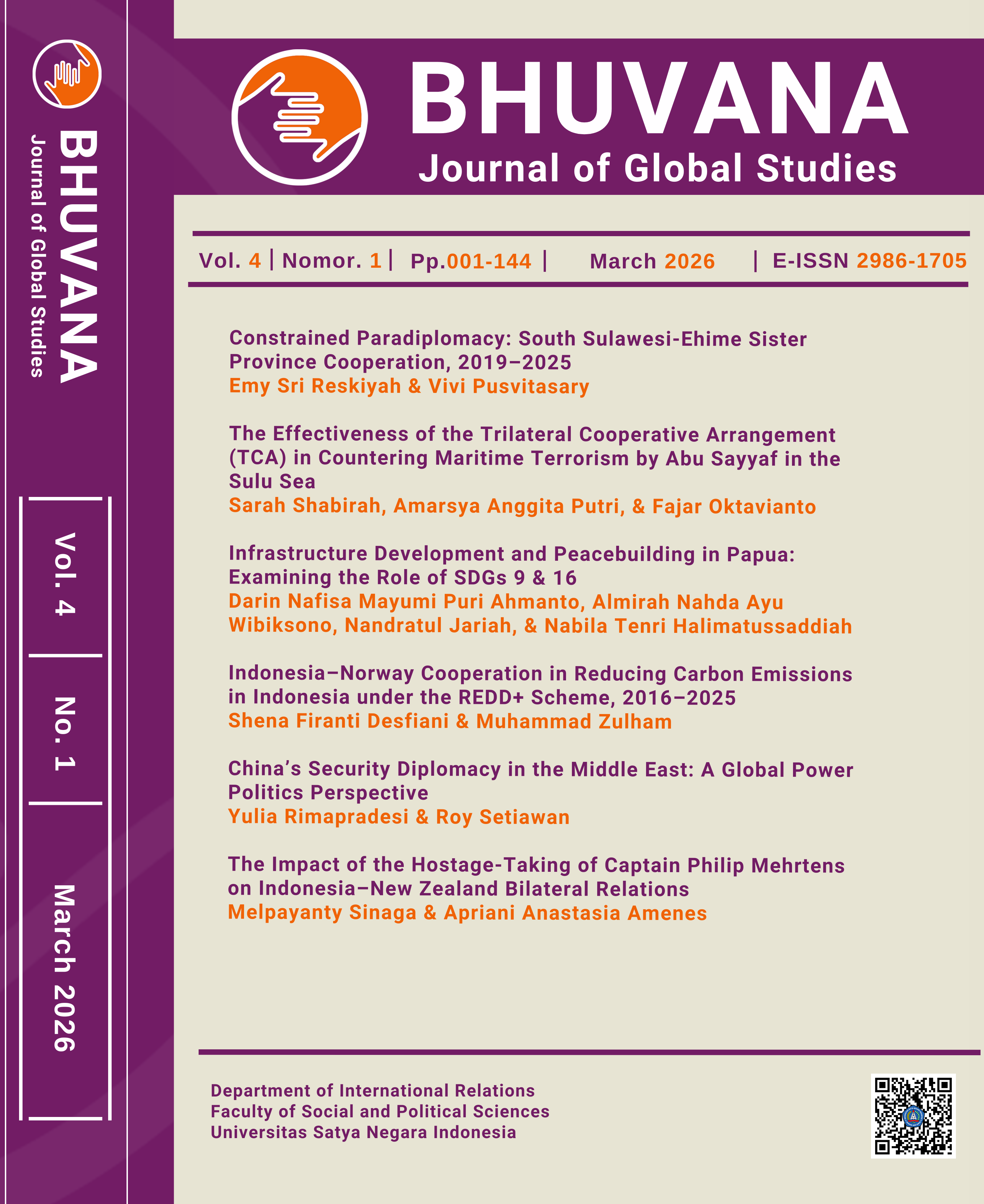
INFRASTRUCTURE DEVELOPMENT AND PEACEBUILDING IN PAPUA: EXAMINING THE ROLE OF SDGS 9 AND 16
DOI:
https://doi.org/10.59408/bjgs.v4i1.275Keywords:
Papua, Peacebuilding, SDG 9, SDG 16, Infrastructure DevelopmentAbstract
This study aims to analyze the role of infrastructure development in supporting the peacebuilding process in Papua, with reference to Sustainable Development Goals (SDG) 9 and SDG 16. Infrastructure development is strategically important for fostering sustainable peace, as the issues in Papua are not only related to security but are also influenced by development disparities, structural poverty, limited access to basic services, and the marginalization of indigenous communities. This study employs a descriptive qualitative method, utilizing a literature review and secondary data analysis. Johan Galtung’s theoretical framework of peacebuilding is used to understand the relationship between infrastructure development and the concept of positive peace. Research findings indicate that infrastructure development have contributed to improved regional connectivity and economic activity among local communities. However, the impact has not yet translated into corresponding improvements in the well-being and social cohesion of Papuan communities. Therefore, the integration of SDGs 9 and 16 is essential to ensure that infrastructure development is not solely focused on economic growth, but also strengthens social justice, inclusive governance, and trust in state institutions as the foundation for sustainable peacebuilding.References
Amil, A. C. (2025). Implementation of SDG 16: ‘Peace, Justice, and Strong Institutions’ in The Philippines: Status, Collaborative Efforts, and Prospects. International Conference on Public Administration and Social Science (ICoPASS), 1(1), 1–18. https://jurnal.untirta.ac.id/index.php/ICoPASS/article/view/29719
Arkam, A., & Widiantoro, W. A. (2025). Analisis kelayakan pembangunan Balai Latihan Kerja Provinsi Papua Tengah di Distrik Wanggar, Nabire. Teknosains: Media Informasi Sains dan Teknologi, 19(1), 76–87. https://doi.org/10.24252/teknosains.v19i1.55379
Bakar, A., Sanusi, A., & Harsono, H. (2024). Controlling the Level of Inequality through Economic Growth in Papua Province. Cross Current International Journal of Economics, Management and Media Studies, 6(4). https://doi.org/10.36344/ccijemms.2024.v06i04.001
Cabui, C. E. (2025). Sinergi Peran Majelis Rakyat Papua untuk Akselerasi Pertumbuhan Ekonomi Daerah Papua. Indo-MathEdu Intellectuals Journal, 6(6), 9917–9927. https://doi.org/10.54373/imeij.v6i6.4350
Chasib, A. (2024). Resolution of The Long Conflict In Papua for Equitable National Development. Jurnal Lemhannas RI, 12(1), 93–100. https://doi.org/10.55960/jlri.v12i1.566
Fabre, A., & Straub, S. (2023). The Impact of Public–Private Partnerships (PPPs) in Infrastructure, Health, and Education. Journal of Economic Literature, 61(2), 655–715. https://doi.org/10.1257/jel.20211607
Hang, K., & Ren, J. (2025). Infrastructure at the Frontier: Development Outcomes in Western Province, Papua New Guinea. Advances in Economics, Management and Political Sciences, 201, 168–176. https://doi.org/10.54254/2754-1169/2025.ld25327
Hansen, T. (2016). Holistic Peace. Peace Review: A Journal of Social Justice, 28(2), 212–219. https://doi.org/10.1080/10402659.2016.1166758
Haq, M. Z., Komariyah, S., & Yuliati, L. (2025). Impact of Infrastructure Development and Poverty on Human Development Index in East Java (2018-2022) Using GWPR. International Journal of Economics, Commerce, and Management, 2(2), 304–315. https://doi.org/10.62951/ijecm.v2i2.614
Hasan, H., & Nugroho, Z. (2022). Menuju Papua Damai dengan Pendekatan Pembangunan Inklusif. Jurnal Ilmiah Hubungan Internasional, 56–66. https://doi.org/10.26593/jihi.v0i00.5973.56-66
Mollet, J. A., & Silo, A. (2024). Green Economic and Local Wisdom toward Sustainable Development in West Papua, Indonesia. RSF Conference Series: Business, Management and Social Sciences, 4(1), 180–185. https://doi.org/10.31098/bmss.v4i1.874
Munawaroh, S., & Haryanto, T. (2021). Development of Infrastructure and Economic Growth of Papua Province. Media Trend, 16(1), 19–31. https://doi.org/10.21107/mediatrend.v16i1.7454
Musaád, M. A. (2025). Contextualizing Asymmetric Decentralization in Papua in the Context of Sustainable Development Goals. Journal of Lifestyle and SDGs Review, 5(1), e04705. https://doi.org/10.47172/2965-730X.SDGsReview.v5.n01.pe04705
Nababan, J., Rante, H., & Rusim, D. A. (2022). Analisis Dampak Pembangunan Ruas Jalan Nasional Wamena-Mulia-Sinak. Jurnal ELIPS (Ekonomi, Lingkungan, Infrastruktur, Pengembangan Wilayah, dan Sosial Budaya), 5(2), 45–55. https://doi.org/10.31957/jurnalelips.v5i2.2398
Putri, A. S., Mutmainna, A. Z., Wardoyo, H. F., & Febriansyah, M. R. (2024). Official Development Assistance (ODA) Kanada dalam Upaya Mengurangi Kemiskinan dan Memperkuat Hak Asasi Manusia di Negara Berkembang dan Afrika Tahun 2018-2022. BHUVANA: Journal of Global Studies, 2(1), 1–30. https://doi.org/10.59408/bjgs.v2i1.147
Rais, L., Ramli, U., Halik, W., Mardliyah, U., & Hidaya, N. (2023). Analisis Konflik Politik Pasca Pembentukan Daerah Otonomi Baru. Jurnal Sosiologi Andalas, 9(2), 106–124. https://doi.org/10.25077/jsa.9.2.106-124.2023
Said, A., Mustofa, M. Z., & Sulaiman, F. A. (2025). The Influence of the Education Index, Health Index, and Expenditure Index on Poverty Level Reduction: A Study of Papua Province. Dinasti International Journal of Education Management and Social Science, 6(6), 4328–4340. https://doi.org/10.38035/dijemss.v6i6.4949
Sarjito, A. (2024). Dampak Konflik Sosial Terhadap Implementasi Kebijakan Otonomi Daerah di Papua: Studi Kasus Keamanan Daerah. JIANA (Jurnal Ilmu Administrasi Negara), 22(1), 1–16. https://doi.org/10.46730/jiana.v22i1.8161
Sihaloho, R. A. H., Hanita, M., & Pamungkas, C. (2023). Papua Conflict Resolution Challenges: The Linkage of Relative Deprivation with the Spirit of Separatism of Indigenous Papuans. Journal of Namibian Studies: History Politics Culture, 3(4). https://doi.org/10.59670/jns.v34i.2130
Sokoy, F. (2022). Economic Development of Indigenous Papuans: A Critical Analysis to Build Independent and Dignified Traditional Villages. Journal of Social Science, 3(6), 1233–1246. https://doi.org/10.46799/jss.v3i6.437
Theotama, G., & Syahputra, Y. B. (2024). Sustainable Development Program: Synergism Integrated Farming System Implementation in Tambrauw, West Papua with A Holistic Approach. Jurnal Indonesia Sosial Sains, 5(10), 2512–2523. https://doi.org/10.59141/jiss.v5i10.1441
Titalessy, P. B., & Situmeang, R. J. (2023). Analysis of Government Expenditure on Inclusive Economic Development in Papua. International Journal of Environmental, Sustainability, and Social Science, 5(4), 1181–1198. https://doi.org/10.38142/ijesss.v5i4.1135
Titalessy, P. B., Situmeang, R. J., Mulyono, H. I., & Patty, R. (2024). Analysis of Inclusive Economic Development and Its Driving Factors in Papua Province. Society, 12(2), 758-775. https://doi.org/10.33019/society.v12i2.743
Wanggai, L. L. (2022). Social Capital Strengthening Model in the Framework of the Employment Expansion for Native Papuan in Manokwari District, West Papua. Annals of Management and Organization Research, 3(2), 153–163. https://doi.org/10.35912/amor.v3i2.1305
Wany, E., Yuliarini, S., & Prayitno, B. (2022). Physical and Non-Physical Infrastructure Development Leverage Human Development in Papua Province. Media Mahardhika, 21(1), 62–70. https://doi.org/10.29062/mahardika.v21i1.522
Downloads
Published
How to Cite
Issue
Section
License
Copyright (c) 2026 Darin Nafisa Mayumi Puri Ahmanto, Almirah Nahda Ayu Wibiksono, Nandratul Jariah, Nabila Tenri Halimatussaddiah

This work is licensed under a Creative Commons Attribution-NonCommercial-ShareAlike 4.0 International License.